Gardening

I have cut back the hedge.
I’d started with the hand held shears, but I couldn’t reach very high. Michael had always trimmed the hedge while I held the ladder, and his arms were much longer than mine.
So at first my efforts were distinctly wonky. I decided to borrow Ali and Dale’s long electric trimmer.
I’ve never used a powertool - never wielded a chainsaw or even used a whipper snipper. So I asked the girls to come outside and help, half thinking I was likely to fall over or amputate a toe or something. But I didn’t.
I trimmed the hedge and it is now (sort of) straight. I felt inordinately proud.
I was on a roll. I went down the back yard to trim the edges (with the hand held shears once again)
I kneel down and clip the grass.
It is slow work. I notice my breathing becomes steady.
New details of the world at ground level come into sharp relief. I notice the ferns have new light green fronds.

I cut the grass back from the mossy rocks.
I’ve been reading about Iris Murdoch’s ideas on the morality of attention. She said the essence of moral life is not to be found in isolated moments of action or decision, but in our ongoing reflective activity — how we attend and respond to particular persons and things from moment to moment. Murdoch writes in, Metaphysics as a Guide to Morals (1992), ‘Moral change comes from an attention to the world whose natural result is a decrease in egoism through an increased sense of the reality of, primarily, other people, but also other things.’
I bold the words that stand out to me.
I’m not sure that paying attention to the natural world, whilst gardening, is a moral act in itself. But maybe it can help facilitate a mindset similar to what the Buddhist tradition would call ‘non self’ or anatta. Letting go of the ego in order to pay attention to the world, moment by moment.
This reminds me of Satre, who labelled human consciousness as "being-for-itself." Rather than a fixed identity, Sartre say selfhood as being in a perpetual state of flux.
'Being is. Being is in-itself. Being is what it is.' Sartre, Being and Nothingness (1943)
This idea of a fixed ‘self’ that Satre challenges is, of course, a uniquely Western construct. I wonder whether the Dharawal people, the original custodians of this land, had a concept similar to the Western idea of the ‘ego’...
I look up the University of Wollongong publication DHARAWAL. The story of the Dharawal speaking people of Southern Sydney. (2001) This is a collaborative work by Les Bursill, Mary Jacobs, artist Deborah Lennis, Dharawal Elder Aunty Beryl Timbery-Beller and Dharawal spokesperson Merv Ryan .(Copyright text and illustrations Mary Jacobs, Les Bursill)
I read the section ‘Understanding Country … The importance of the Sky, Land and Sea to the Dharawal People’. It says, ‘All the elements of the natural world, the earth, the sea and the sky are aspects of the unique relationship that all Aboriginal people have with the world. Aboriginal people believe that the Spirits that created the world as it is now, all descend from spirits who once lived in the sky. Every aspect of the world we see now was created in response to the needs of those spirits. All features of the natural earth represent parts of the spirit dreaming and are repeated in the dreamings of the people who now inhabit the earth.’ It seems that the people are not separate to Country. The sense of ‘self’ is intimately intertwined with nature.
The publication goes on, ‘ Just as rocks, trees, rivers, soil, the ocean have a connection to that dreaming so each also has a connection to the totems of the people. Each animal, snake, fish lizard or insect has its totem and they also have a direct connection to their ancestral origins in the sky. Those spirits live on in the ‘Country’ right now.’
Country is a part of us, just as we are part of Country.
This spiritual connection with Country means that the individual is not separate from the land.
Michael loved to garden. He taught me so much that he had learnt from his Dad, growing up on the farm in Pucawan.
He started our collection of indoor plants so we could have living green things throughout the house. After he got sick he still managed to muster the energy for a Friday trip to the farmer’s markets on Crown Street. There he would chat with the farmers who came into town to sell their wares, and always come home with a bunch of fresh flowers for the lounge room.
Even just a few weeks before he died, he came downstairs and sat on a chair in the back yard, watching as we dead headed the daisy bushes and planted baby spinach in the raised garden beds.
Michael had planned to join a volunteer bush regeneration group in his retirement. One weekend we volunteered together on a Sunday to help out at the local Rhododendron and Rainforest Garden. This beautiful garden has a section of introduced species and a separate section of preserved local rainforest. It's been going since 1969, managed and maintained by a group of volunteers. One of the volunteers popped by to chat where we pulled up weeds. She was 96 years old, still visiting the garden regularly to oversee the ongoing work. We talked about doing it together, and imagined when we were old and grey still pottering about, pulling up weeds and planting Australian natives.
I look up the Wiradjuri artist and poet jazz money. I'm wondering if they have written anything that will sum up what I am trying to grasp. I find this instillation …
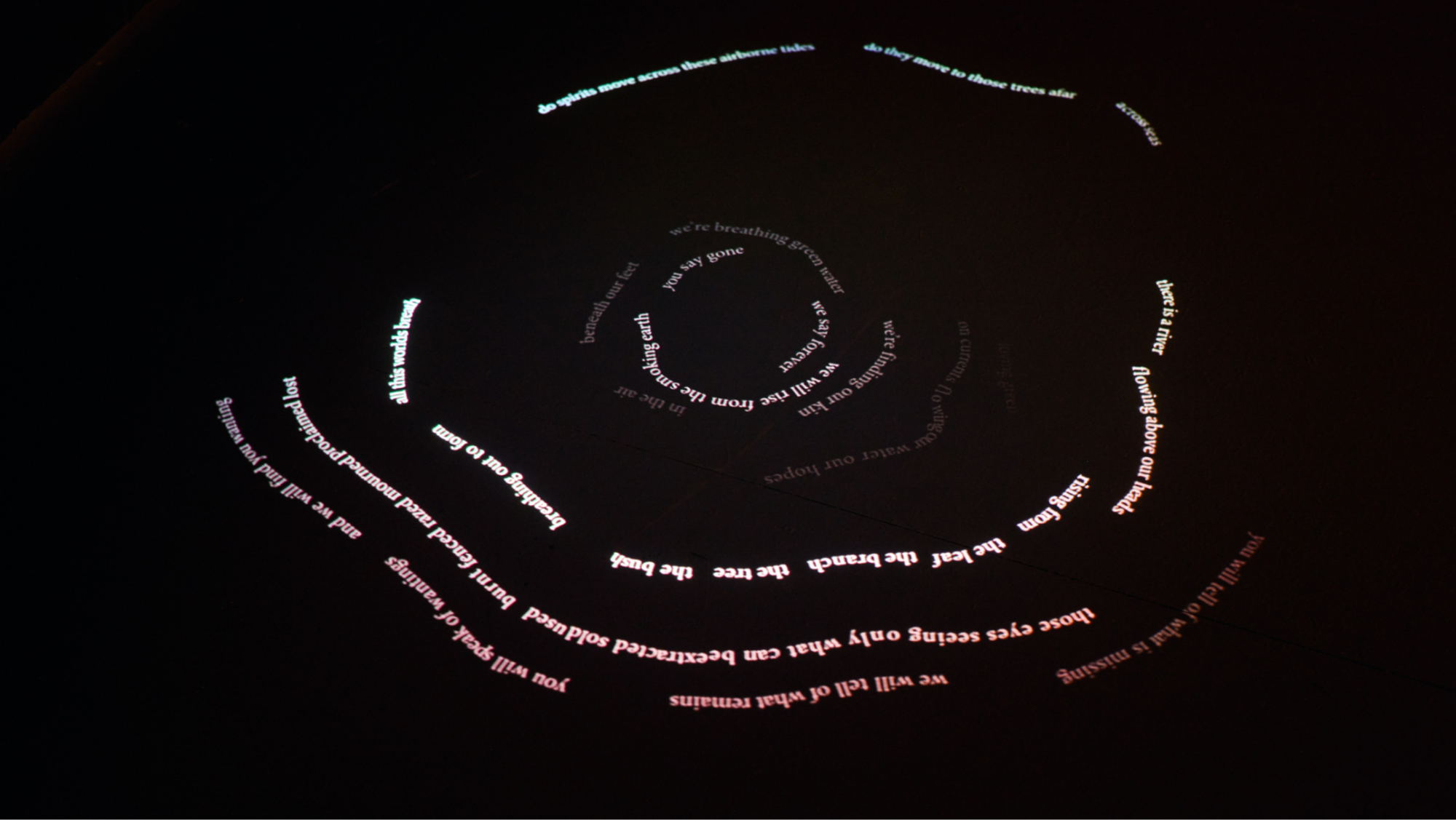
garrandarang (2021) installation view at Out of the Everywhen, Plimsoll Gallery, University of Tasmania, 2023. Photo by Rémi Chauvin.
jazz money writes, ‘There is an ancient landscape beneath our feet. One full of care, of knowledge, of love and song. No colonial intervention can alter the truth of Country. This work is not a eulogy to the forests that should stand here, it is a reminder they still stand. As Australian forests dwindle, our eucalypts spread unwelcome offshore. Do our ancestors follow them, to continue a relationship older than time?’
Yes
The grief and the sorrow.
The understanding of Everywhen.
Their website says, ‘jazz money creates visual artworks that expand upon their poetic practice. Fascinated by how poetry lives in the body and in place, these works invite audiences to consider story as an ongoing active experience.’
Yes
Poetry lives in the body and in place.
That’s what I was trying to say.